some things
This is a vaugely time-ordered list of things.
Why do microwave magnetron outputs have holes if they're not waveguides?
2019-10-26 #1
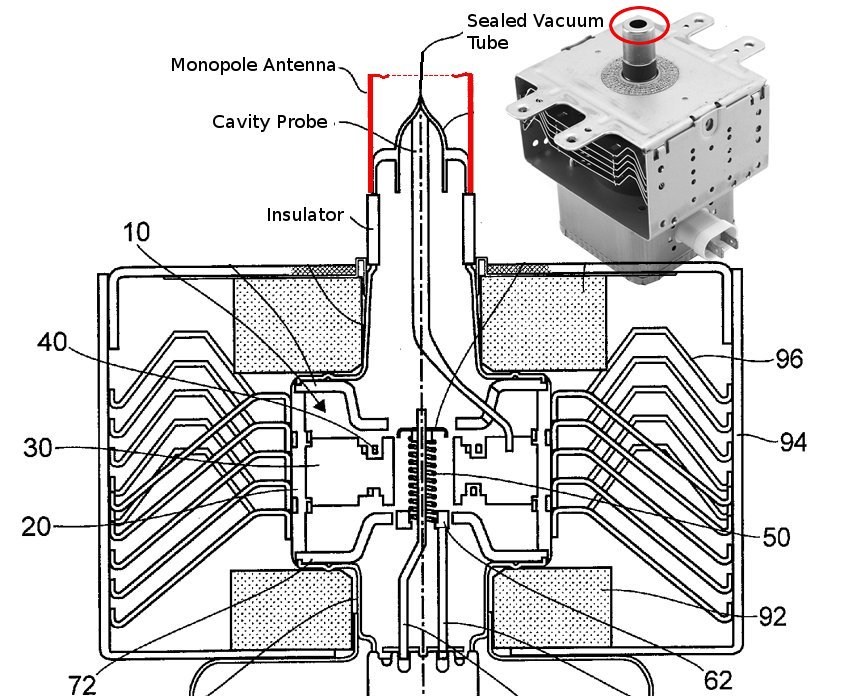
I've been looking at a lot of microwave oven magnetrons lately. One thing that vexed me was why they all seem to have a hole in the cap on their output. Initially this predisposes you to think that it's an aperture of a waveguide. But the wavelength of of 2.4 GHz in air is way to large for the size of the 'waveguide'. For a 'waveguide' that small it'd only support about 15 GHz wavelength as the lowest frequency and support up to some ~20 GHz before high end cut-off.
It's actually a monopole antenna with a dielectric standoff. The fatter the monopole the greater the bandwidth generally, and the larger the better heat tolerance, and the lower the e-field gradients. So it makes sense to use a fat cylinder for the monopole. But what doesn't make sense is that there's a hole in the end of it. In all of them.
After reading a few patents I think I know why. Originally the vacuum evacuation tube comes out of the top of the magnetron. It's normally closed off but it's still under the antenna cap. If the antenna has a hole in it then the magnetron can be tested somewhat normally while still being hooked up to the vacuum pump. That's my guess. I can't think of any other reason for it beyond letting hot air out of the cavity beneath the antenna.
An easy modification to suppress noise from a household magnetron
And how magnetrons can be used as reflection amplifiers
2019-10-24 #2
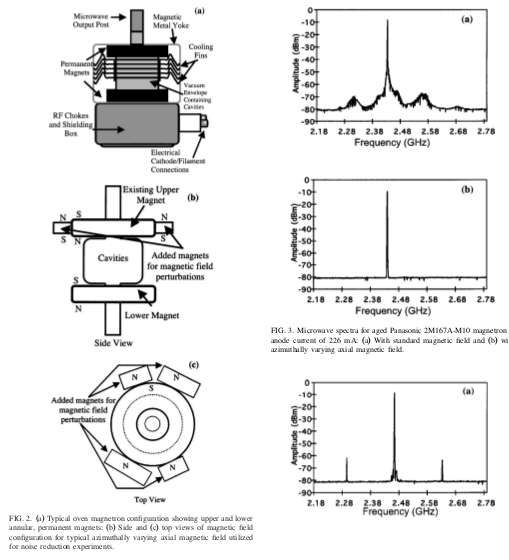
Low-noise microwave magnetrons by azimuthally varying axial magnetic field_ V B Neculaes_ R M Gilgenbach_ Y Y Lau_ 2003
This paper documents how sticking (literally) some extra magnets on the top magnet of a microwave magnetron gets rid of most of the noise around the carrier. Unlike other methods of running a magnetron in a low noise mode this way requires no invasive modifications and you can still run the cathode heater to get full power output. This is at all relevant because there exists a way to use a household magnetron as an amplifier (ref pdf).
Reference material /library/Electromagnetics/Magnetron
There are two ways in the literature to use a microwaven oven magnetron as a reflection amplifier (w/circulator). Both of them modulate the anode current, which is to say, the rate at which electrons travel from the cathode to the node in the coaxial cavity surrounded by resonating cells.
The first and easiest way to do this is to change the magnetic field projecting down vertically through the cavities. An additional electromagnet coil is added to contribute (or subtract) from the the permanent magnets. The current in this coil is controlled by a phase locked loop. But the current through the coil can't be changed rapidly so this kind of amplifier can't be used with phase modulation schemes.
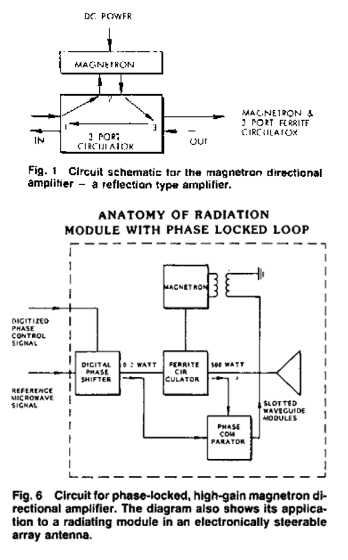
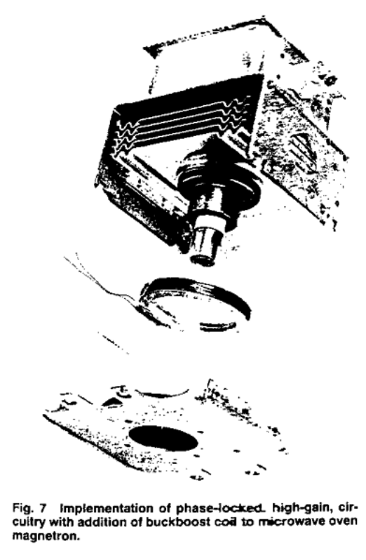
The second and most expensive is to change the actual HV bias current directly by using a switched IGBT HV supply with complex control circuitry. It also uses a PLL but allows for much faster phase modulation.
Both types of set are pretty high noise when there's a lot of cathode heater current supplied (ie, high power). But if the magnetron is started with just a bit of heater power then the heater is turned off the magnetron continues to operate at a much lower noise level and with much less random phase jitter. But this can now be solved by having extra bias field on the top magnet.
Both types require extensive filtering of the AC-DC conversion power supply.
Later...
Characterization and Optimization of the Magnetron Directional Amplifier_ Thesis_ Mike Hatfield_ 1999 - this is by far the best and most authoritive document on using magnetrons as reflection amplifiers.
mkp224o: CPU vanity address generator for tor onion v3 (ed25519) hidden services
2019-10-24 #1
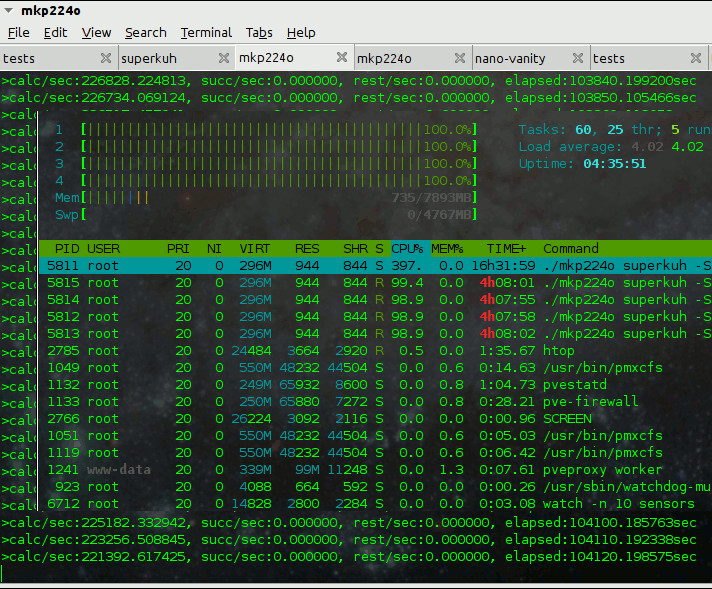
I've recently been trying to upgrade my tor setup and that means version 3 addresses using curve25519 56 char hashes. As of right now there are no GPU implementations for mining. That means CPU mining and it's really slow. Maxing out an i5 3570k it would take about 2 weeks (on average) to brute force a superkuh* prefix. But I don't want to only do that for two weeks so I'm throwing it on my fanless 5w Celeron N3150 which I *can* let run for as long as I want quitely. With it's hash rate it should take about 2 months. But it's random and could take much more or less.
There are some alternative cryptocoins out there that use the same curve25519 algorithm which have opencl GPU implementations but who knows (not me) how one would adapt the opencl bits for tor v3 addresses. https://github.com/PlasmaPower/nano-vanity. The real vanity here is thinking I can poke at this crap and get it to work. I can't. I'll just have to wait the 2+ months.